
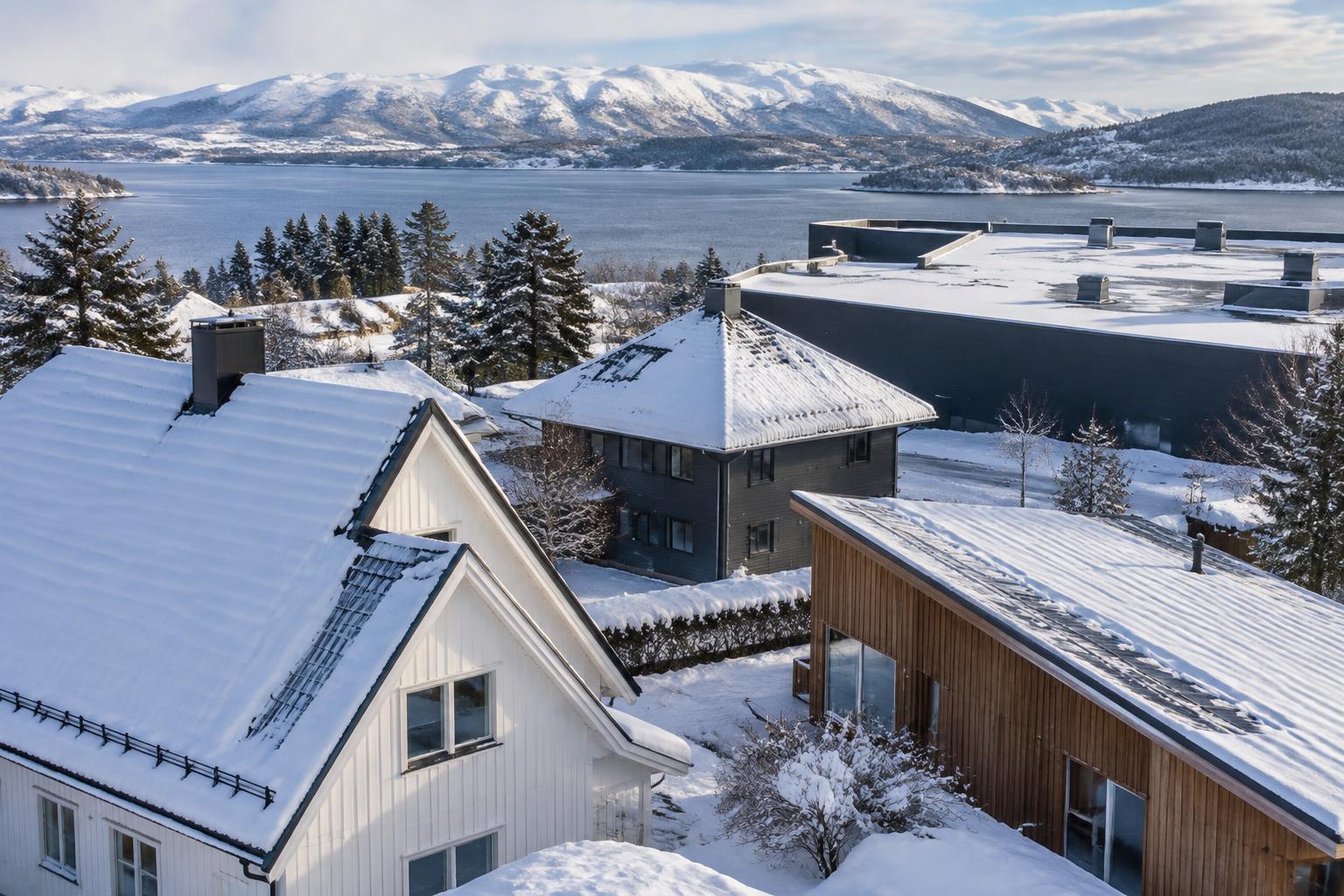
Roof slope and snow are closely connected, but roof pitch alone does not determine how a building performs during winter. A steep roof can encourage snow to slide, while a shallow or flat roof can retain more snow. However, roofing material, wind, roof geometry, snow guards and local snow loads can all change the outcome.
A roof designed for Nordic winters needs to balance two things: controlling the amount of snow that remains on the structure and preventing uncontrolled snow release. A simple roof shape with an appropriate pitch can make snow management more predictable, but even a well-designed roof can experience changing loads during a heavy winter.
A snow load monitoring system gives building owners and facility managers a way to understand how the actual roof load changes during winter, rather than relying only on the roof pitch and design calculations.
How does roof slope affect snow load?
The relationship between roof pitch and snow load is described using a snow load shape or slope factor. In Eurocode EN 1991-1-3, the relevant factor is expressed as μ.
In simplified terms, increasing roof pitch can reduce the amount of snow assumed to remain on the roof in certain balanced snow load situations. However, this does not mean that a steep roof is automatically safe from snow-related risks.
For roofs with lower pitches, snow is more likely to remain on the surface. As the pitch increases, the possibility of snow sliding increases. The exact design approach depends on the applicable standard, roof geometry and other site conditions.
How roof pitch changes snow behaviour
A steeper roof can therefore reduce some aspects of accumulated snow loading while increasing the risk of snow sliding or roof avalanches.
This is why roof slope and snow should always be considered together with the roofing material and the areas below the roof edge.
| Roof pitch | Typical snow behaviour |
|---|---|
| Low slope | Snow is more likely to remain and accumulate |
| Moderate slope | Snow may gradually shed depending on the surface |
| Steep slope | Snow is more likely to slide |
| Very steep smooth roof | Sudden snow release can become a safety concern |
Why does roofing material matter as much as roof slope?
Roof pitch does not work in isolation. The surface of the roof affects how easily snow can move.
Rougher materials can hold snow for longer, while smoother materials such as some metal and slate roofing can allow snow to slide at relatively low pitches.
This creates an important distinction: A roof that sheds snow well is not necessarily a roof with no snow risk.
If snow slides suddenly from a smooth, steep roof, it can fall onto entrances, walkways, driveways, parked vehicles, lower roofs, and equipment around the building.
On the other hand, if snow remains on a shallow roof, the main concern may be the increasing structural load.
This is why both snow retention and snow release need to be considered when designing or managing a roof in a snowy climate.
NevoSens snow load sensors can measure changes in actual roof load continuously, helping building owners understand how the load develops regardless of roof pitch or roofing material.
Which roof shape is best for snow?
There is no single roof shape that is perfect for every Nordic building. However, simpler roof geometries generally make snow behaviour easier to understand and manage.
Shed roof
A shed roof has one continuous slope, which makes snow movement relatively predictable.
A suitable slope can encourage snow to shed in one direction, provided the roof surface and local conditions allow it.
The main consideration is where the snow will land. If the roof drains or sheds snow toward an entrance, walkway or other occupied area, additional snow protection may be required.
The lack of valleys also reduces the number of natural snow accumulation points.
Gable roof
A gable roof is one of the most common roof shapes in Nordic construction. Its two slopes can provide effective snow shedding when the pitch and roofing material are suitable. The simple geometry also makes the roof relatively straightforward to analyse.
However, wind can create asymmetric snow loading. Snow may be removed from one slope and deposited on the other, meaning the two sides of the roof do not always carry the same load.
This matters particularly during strong winds and heavy snowfall.
Hip roof
A hip roof has slopes on four sides and can perform well structurally. However, its more complex geometry can create areas where snow accumulates, particularly around changes in direction and roof intersections.
These accumulation areas should be considered separately during design and winter inspections.
Mansard roof
A mansard roof has two different slopes on each side. The shallower upper section can retain more snow, while the steeper lower section may encourage snow movement. The transition between the two slopes can also become an area where snow accumulates.
For this reason, mansard roofs require more careful consideration than a simple single-slope roof.
Flat roof
Flat roofs present a different snow management challenge. Because snow cannot normally slide away through gravity, accumulation can continue during repeated snowfall. Parapets and rooftop equipment can also influence how wind moves and deposits snow.
Drainage is another important consideration. During periods of thawing and refreezing, blocked or frozen drainage can contribute to additional water weight.
For large commercial and industrial buildings, this makes ongoing snow load assessment particularly important.
What is the best roof pitch for snow?
There is no single best roof pitch for snow that applies to every building.
The appropriate pitch depends on local ground snow load, roofing material, roof geometry, building location, wind exposure, snow guards, areas below the roof, structural design, and drainage requirements.
A steeper roof generally encourages snow shedding, while a shallower roof generally retains more snow.
But increasing the pitch also increases the possibility of uncontrolled snow release. Therefore, the goal is not simply to make the roof as steep as possible.
The better approach is to choose a roof pitch that works with the building's location, material and intended snow management strategy.
The roof avalanche problem
One of the biggest disadvantages of a steep roof is that accumulated snow can release suddenly.
This is particularly relevant for smooth roofing materials. A large snow layer can remain in place until temperatures, sunlight or other conditions cause it to start moving.
Once the snow begins to slide, a large amount can move in a very short time. This can create hazards for people, vehicles and equipment below the roof.
Snow guards can help control this risk by retaining snow and breaking up large releases. However, their installation also changes how snow remains on the roof.
Therefore, snow guards need to be considered as part of the roof's structural and snow-management design rather than as a simple add-on.
How do snow guards affect roof slope and snow load?
Snow guards are particularly important where snow could slide onto areas used by people or vehicles.
They can reduce the risk of sudden snow release by holding snow on the roof and allowing it to melt or release in a more controlled way.
However, retaining snow also means that the roof may need to carry more accumulated snow than it would if the snow could slide away. This is why roof slope and snow guards should be assessed together.
The structural design should account for the snow load cases applicable to the roof, including the effect of snow retention systems.
Why asymmetric snow load matters
A balanced snow load assumes that snow is distributed relatively evenly across the roof. Real winter conditions can be very different.
Wind can move snow from one roof slope to another and create concentrated snow drifts. The result can be a much higher local load on one part of the structure.
This is especially important for gable roofs, roofs with parapets, valleys, dormers, changes in roof elevation, and buildings next to taller structures.
A roof can therefore have an appropriate pitch and still experience significant local snow accumulation.
What does Eurocode say about roof slope and snow?
European structural design uses EN 1991-1-3 for snow loads. The standard considers factors such as roof shape and snow distribution when determining the design snow load. For common roof configurations, roof pitch affects the applicable shape coefficient.
However, the design should not rely on pitch alone. Wind redistribution, drifting, roof geometry and other relevant load cases also need to be considered.
For Nordic buildings, the local snow climate is particularly important because ground snow loads can vary significantly between coastal, lowland and mountainous areas.
The final design value therefore depends on the building location and the applicable national provisions.
How does roof complexity affect snow accumulation?
Simple roof geometry is generally easier to manage in snowy climates. Every additional valley, roof intersection, dormer or change in elevation can create another location where snow may accumulate.
Complex roof designs can therefore require additional attention during both structural design and winter monitoring.
When planning a building in a heavy-snow region, consider keeping rooflines relatively simple, limiting unnecessary valleys, planning rooftop equipment carefully, considering where snow will fall from steep slopes, protecting entrances and walkways, providing suitable drainage, and accounting for local snow drift conditions.
The goal is not necessarily to eliminate complex roof shapes, but to understand where they can create additional snow loads.
Minimum roof pitch for different roofing materials
The minimum practical roof pitch varies according to the roofing system, manufacturer requirements, climate, and structural design.
Asphalt shingles
Asphalt shingles are commonly used on pitched residential roofs. The required minimum slope depends on the specific roofing system and applicable building requirements.
In snowy regions, the roof design also needs to consider snow retention, ice formation, and drainage.
Metal roofing
Metal roofs can be installed at relatively low pitches depending on the profile and manufacturer specifications.
However, smooth metal surfaces can allow snow to slide unexpectedly. A steeper metal roof may therefore require snow retention measures where snow could fall onto occupied areas.
Natural and synthetic slate
Slate can provide a durable roof surface, but its smoothness can allow snow to move more easily. The appropriate pitch depends on the specific slate system, installation method, climate, and structural design.
Single-ply membranes
PVC, TPO, and EPDM membranes are commonly used on low-slope and flat commercial roofs.
Because these roofs generally retain snow rather than shedding it through slope, structural design and drainage become particularly important.
When roof slope alone is not enough
Roof pitch tells you something important about how snow may behave, but it does not tell you how much snow is actually sitting on the roof today.
A roof can meet the required design conditions and still experience changing loads because of unusually heavy snowfall, wet and dense snow, rain falling onto existing snow, wind-created snow drifts, repeated freeze-thaw cycles, changes to the building, or deterioration or damage to structural components.
This distinction is particularly important for large buildings.
For residential properties, regular inspection and appropriate snow management may be sufficient in many situations. For large warehouses, sports halls and industrial buildings, continuous monitoring can provide additional information about changing roof loads.
Can roof snow load be monitored in real time?
Yes. Sensor-based systems can measure changes in roof load continuously.
This can be particularly useful when the roof area is very large, access to the roof is difficult, several buildings need monitoring, manual inspections are time-consuming, the building remains occupied throughout winter, or snow conditions can change quickly.
Real-time monitoring does not replace structural engineering or professional inspection. Instead, it provides an additional source of information about how the actual roof load is changing.
What is the safest roof shape for Nordic winters?
For many snowy environments, simple roof geometry combined with an appropriate pitch provides the most predictable snow behaviour.
Simple shed and gable roofs have fewer internal valleys and accumulation points than highly complex roof designs.
However, the safest solution depends on the complete building design.
A steep, smooth roof may reduce accumulated snow while increasing the risk of sudden snow release. A shallow roof may reduce avalanche risk while retaining more snow on the structure.
The best design therefore balances structural capacity, local snow load, roof pitch, roofing material, wind exposure, snow retention, snow release, drainage, and pedestrian and vehicle safety.
Final thoughts
Roof slope and snow should never be treated as a simple question of whether a roof is steep or flat.
Steeper roofs can encourage snow shedding, but they can also create sudden snow-release hazards. Shallow and flat roofs tend to retain more snow, making structural load and drainage more important.
Simple roof shapes such as shed and gable roofs can make snow behaviour more predictable, while valleys, dormers and changes in roof elevation can create additional accumulation zones.
Most importantly, roof pitch only describes the design geometry. It does not tell you how much snow is actually on the roof during a particular winter event.
For large commercial and industrial buildings, combining appropriate roof design with real-time roof load monitoring can provide a clearer picture of changing winter conditions.
Frequently asked questions
What is the best roof pitch for snow?
There is no single best pitch for every snowy region. A steeper roof generally encourages snow shedding, while a shallower roof retains more snow. The appropriate pitch depends on the roofing material, local snow load, structural design and how snow will be managed around the building.
Does roof slope affect snow load?
Yes. Roof slope can affect the amount of snow assumed to remain on a roof in structural snow load calculations. However, wind, roof geometry, roofing material and snow retention systems can also affect the actual load.
Is a 4:12 roof pitch good for snow?
A 4:12 pitch can work well in many applications, but whether it is suitable depends on the roofing material, local snow load and structural design. It should not be treated as a universal minimum for every snowy region.
Does a metal roof shed snow better?
Metal roofing can allow snow to slide more easily than some rougher roofing materials. This can reduce snow retention but increase the risk of sudden snow release. Snow guards may therefore be needed where falling snow could create a hazard.
Which roof shape sheds snow best?
Simple steep shed and gable roofs can shed snow predictably when the roofing material, pitch and surrounding conditions are appropriate. Complex roofs with valleys and changes in elevation can create additional snow accumulation areas.
Why does wind matter for roof snow load?
Wind can move snow from one part of a roof to another, creating uneven or concentrated snow loads. This means that a roof can experience significantly different loading on different sections during the same snowfall event.
Can roof snow load be monitored in real time?
Yes. Roof load sensors can continuously measure changes in roof loading and provide data that helps building owners and facility managers understand changing winter conditions. This information complements, rather than replaces, structural assessment and professional inspection.
Next step
Want to see how roof load monitoring would work on your buildings?
We review your properties, suggest sensor placement and show you how the portal looks in operation. Free of charge and without commitment.